Showing posts with label sons. Show all posts

Wednesday, June 18, 2014

Studies Show That the Breakdown of Parenting into Quantifiable Units Demonstrates That it is Largely Chore-Based

I'm thinking about parenting, and little boys, and autism spectrum disorder, and I'm thinking, again, about the way social media is a place to telegraph triumphs in the name of positivity while all of the challenges often remain unacknowledged, neither tweeted nor prominent displayed in status updates.

However, in the interest of full disclosure, you must know there are days where my five-year-old boy has me on the brink of a nervous breakdown. I don't know whether you can chalk it up to age, gender, and/or diagnosis, but being in the house with him is maddening: he doesn't talk to me about his day, he doesn't draw at the table with paper and markers, he doesn't race his Hot Wheels down the long hallway; he pinballs off the walls and furniture while making repetitive, nonsense vocalizations, and this is interspersed with opening and closing the microwave twenty times, sliding open and closed the closet doors, opening and closing the freezer, and turning the sink water on and off over and over and over again. His energy is intense and odd, and his toys remain relatively unplayed with. Then, when we leave the house, he's always afflicted with the ants-in-his-pants jitters, and if I don't keep my eye firmly on him, he'll be gone. It happened twice at the aquarium today. I was looking at a fish, and he was already in another exhibit.

Beyond this, it seems important to also mention that parenting-- which, contrary to what you may have heard-- is not always "rewarding." Perhaps, yes, in the long run when our children are moulded, with our help, into high-functioning adults: I'll use the word "rewarding" then. In the meantime, in the interest of honesty, parenting often feels like a burdensome chain of chore-based activities. From the preparation of breakfast, which must be accompanied by teaching moments (How do you ask to leave the table? Use your napkin. Don't scratch the table with your fork. And so on.) all the way to reading that bedtime story, which I can't skip because of how important it is to his future as a reader. Frankly, my friends, I'm exhausted. Parenting (on a case-by-case basis, of course) can have you close to pulling out your hair or bursting into tears. Or drinking too much wine at the end of the day, which is better, I guess, than bringing a sippy cup of gin to the mall for a mommy playdate.

And yet, and yet, and yet. It's all so paradoxical, isn't it? It's not as though I've ever thought, "Send him back." Or "Why did I become a mother?" Or "Get me the hell out of here." In fact, anytime I've ever felt that my motherhood was threatened, ever worried about my son's well-being, I've become distraught. I've wept from the immensity of my love for my boy. He is my life now, for better or for worse, and I wouldn't trade him for more nights alone in the bathtub with a pile of soggy New Yorkers stacked on the floor next to me.

Which gets me to the other half of the better or worse equation. Of course we're going to telegraph those triumphant moments, the betters for the worsts. Because those moments feel like shining achievements of sanity. Those are the "aha!" moments that remind us why we ever gave up going to shows, taking quiet trips to the art museum, or enjoying loosey-goosey nights out with the girls. Take, for example, this morning: My son walks into the kitchen and says, "I was a baby in a different house, but this is the house where I'm going to grow up to be like daddy, just like a seed grows into a tree." And I was like, "Whoa, way to be profound before I've even had my coffee."

Wednesday, March 5, 2014

Unmasked

James Baldwin in Letters From a Region of the Mind makes the observation that “Love takes off the masks we fear we cannot live without and know we cannot live within,” which, on the surface, strikes one as sentiment bordering on the sentimental, as something pat and easily contained on a bumper sticker. Yet, as sentiment, the statement is emotionally accurate. James Baldwin knew the human heart.

Consider this: How much safer were you before love? And then: How much did you wish to cast off the hockey mask and enter the frays of romance, or of childbearing, or, even, of loving a pet that you knew would die before you? We walk around, before love, safe behind the armors of loneliness, and we ask those we deem worthy to strip it all away so that we stand there, a throbbing heart, exposed, the cages of our safety masks and curved ribs as good as gone.


Thus here I stand before you— world, fates, family— all of my masks gone, stripped down to the skin, and I ask, meekly, that you let me be in my nakedness or that you wrap me in the blankets of goodwill. Spare me the excoriation. My husband, late forties, the man I hand-picked and pursued, has just competed in a triathlon, and he is vital, a force, more alive than anyone I know. I see him pushing past all probabilities in terms of mortality, so when he rides his motorcycle home from the hospital at four in the morning after a long night of work, steer the drunk drivers the other way. 

And my son, my one and only child, the one who has already scared me, scarred me, with health concerns and mortal danger, let him outlive me, let him mourn and miss his long-dead mother. He is everyday getting farther away from that proverbial well that wishes to suck him down into darkness. Abnormal MRI, seizures, autism: He’s shrugging them off like a coat he has outgrown. In Mexico, when he fell into the deep-end of the pool, his father watched him plunge below the surface only to paddle up to where he was able to hoist himself over the side of the pool, away from tragedy and back into the waning sunlight. World, fates, family: Be safe and let me be safe.

And my two dogs? The smaller brown one has many years ahead of her. My old, white dog turned twelve last month, and I can see her eyes going milky. Her back legs slip out from underneath her, and I have to hoist her up. All ninety pounds of her. She has gotten more nervous with old age, and she can no longer hold her bowels very well. She doesn’t mean to shit on the floor, and I can feel her shame. She knows something is wrong. I clean it up with no admonishment. I just stroke her until I see her tail wag. In truth, I think she has another two years in her. When I picked her out from the homeless man’s litter twelve years ago, she could fit in a cat carrier. I was not projecting this far into the future; I did not think of her death. I just wanted to let a little love in.


Wednesday, February 12, 2014

Well…I Didn't See That Coming

Shitmotherfuckerfuck. Not, of course, that such profanity was screamed or whimpered, although I was surprised to hear myself whimpering having never heard such a thing before. Yet this is the kind of language I imagined my vagina would use if it could speak. My uterus and its sick heaving, me vomiting over the side of the bed as I approached transition, my asshole puckering and then failing to hold in the shit as I pushed it and my son out at three-thirty in the morning during a particularly cold March morning in Connecticut. Fuck. Motherfucker. Shit. Because birth is just as profane as it is profound. 

I suppose there are the occasional women out there who have the kind of birthing experiences to be envied. Something more like poofing feathery angels from their twats while they scrunch up their motherly faces all slick with a comely sheen of sweat, and then those babies turn into children that flit about and charm the world with their glitter glue and spangled soccer trophies. That’s okay. I don’t need to wish them into the cornfield anymore. After all, we’re made to forget the pain, to abstract it so that we don’t even have the words to describe the way our bodies are mangled. 

But if I had to describe it, I would tell the whole story. That, for example, the birthing suite and it’s tastefully muted walls, beyond a certain point, were details lost in the rage of childbirth. That the Joni Mitchell I had playing— the candy of her voice— could not be heard over my retching and keening. In fact, all of the ways that I thought I had prepared myself were as effective as closing a slider door on the tsunami crushing towards me. 


Oh, but once I couldn’t handle listening to myself whimper anymore, I called it and asked for the epidural. And the anesthesiologist swept in like a goddess in institutional blue. I sat on the end of the bed and leaned over as still and trembling as I could manage between throes, and the thick, blissful needle slipped deep into my back while I hugged the ball of my as-yet unborn son. Then…numbness. Complete, dead, utter numbness. Because she thought I should get some sleep, the epidural was proceeded by a spinal block, and my legs, the whole bottom half of me, were as rubber as bread dough. 

Thus, it seems the telling should end there. That this is the point where what was should overlay quite nicely on top of what should have been. Epidural. Bam. Birth. But— the word should, it only serves to fuel regret, self-doubt, and worthless obligations. It reminds us that although one’s cervix shouldn’t be torn during childbirth, sometimes it happens. When one commences with the process of pressing a human through a hole that begins as little more than a dimple, one should plan to expect anything. So should can be useful after all.

That, for example, my son’s heart decelerated, the machines binging and my husband going to fetch the nurse. That the nurses and doctor rocked my dead legs back and forth to dislodge my son from the birth canal. That I had to push him out before full dilation so that not only did he tear the opening of my vagina, but he rent my cervix. That he came out as pointy as a pinhead. That the doctor was stitching for so long and the blood loss was so significant, my mother almost passed out. That I would be up for more than thirty-six hours. That I would look pale and bloated in post-partum pictures. That my son, fresh from the womb, slick and a little bit purple, would look me in the face as I floated above the experience. That the minute he latched on to my breast, I became his blubbering fool. That even after all this upheaval and hurt, I would have liked to do it again. That by the time it was possible, I couldn’t.

So consider this a public service announcement, reader. Anticipate the unanticipated. The more you know about not knowing, the better prepared you'll be to be unprepared.

Shoulda. Woulda. Coulda.


Friday, June 28, 2013

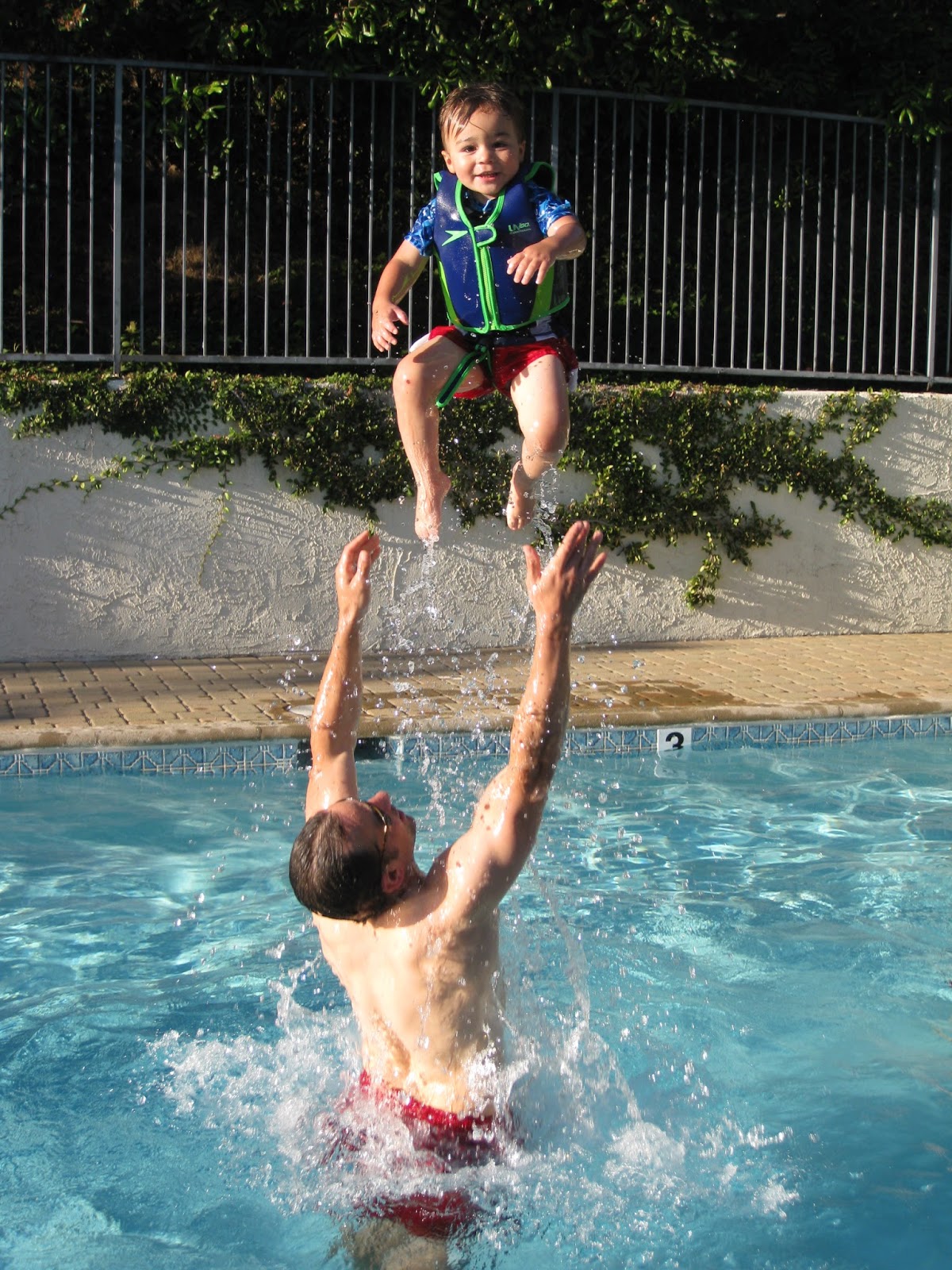
Learning to Swim


The swim school is located in a questionable neighborhood of Burbank where safety notices are left on our car by the Burbank police department, and the neighborhood is populated with apartment buildings noted for their dilapidated tan stucco and names such as “The Sea Breeze” or the “Paradise Palms,” but the only part of the names that are accurate are the palms rising up from the parking medians, which serve to remind us that this is, after all, southern California. Yet you’ll find no sign of sea, breeze, or paradise here as summer tries to suffocate Burbank in its smoldering grip.

But once you walk in through the gate of the Lucile Cowle Swim School, all the oppression melts away. Fountains burble, and Canna Lilies bloom from planters. The smell of sun screen permeates the air. Phil Collins drifts out from speakers dotting the stone walls, and parents with cameras sit under large canvas umbrellas as instructors coax children of all ages to become just a little bit less human and a little bit more aquatic. We come every Monday, Wednesday, and Friday, and the aquariums— a small pool for the babies and a larger pool for the big kids— are teeming with everything from the tiniest minnows to nearly full-grown fish. Some instructors have four-year-olds floating on their backs like otters. Other instructors are cheering on five-year-olds learning to tuck into a dive like penguins in goggles. I watch my son, just four-years-old, leap unafraid off the white diving board into the eight-foot deep water. It is a great and terrifying moment.

According to an article on Slate, Drowning is the number two cause of death in children under the age of fifteen, and the Instinctive Drowning Response doesn't look like drowning. It looks like a person pushing down against the surface of the water, unable to speak, and struggling to breathe. I have a close friend who knows a woman who lost a child to drowning. My brother was on a field trip in high school, and one of his classmates drowned in a pool they were all swimming in when it happened. I read a poem once about drowned twins: five-year-olds clasping hands at the bottom of a neighbor's pool. It's no wonder that some of us parents coach from the sides of the pool. 

My memories of swimming begin in my grandparent’s pool on Fremont Street, when all the neighborhood kids would come over on the hot days to play. I floated around in the kind of orange life-vest you wear on boats, but floating around wasn’t enough for my mother. My swimming lessons were held in the mornings, before summer camp, when the air was still cold. The pools were never heated, and my strongest memories of learning to swim are visceral: gripping a kick board, legs churning, teeth chattering. When the lessons were done, and I was dressed for the day and finally warmed up, I felt a little wrung out and rubbed down by the cold water.

Now I watch my son as he tries to learn how to push off the wall of the pool and glide to his instructor, who offers him the appropriate high-fives when he follows instructions. I watch him kick his legs wildly as his arms flail at the water when he forgets about “big arms and scooping hands.” Every time we visit the pools, he does a little bit better. But sometimes he pushes off the wall, and instead of gliding to his instructor, he goes under. His head is gone, just like that. But then he sputters, laughs, and once again tries to execute the glide, scoop, and kick that constitutes swimming. 

In the rippling oasis of Lucile Cowle’s swim school, I watch some kids sink as their instructors lift them back up to the surface. I watch tiny, blond girls in frilly swimsuits whose spastic movements look like ecstatic drowning, but really it's swimming without coordination, and it's a delightful thing to see. When my son is done with his lesson, I change him into dry clothes and he picks out a red lollipop, which glows in the sun on the way back to our car where a notice about carjacking is pinned under the wiper. 


Tuesday, March 19, 2013

The Other Polarizing Disorder


Sometimes, late at night, well into my second glass of wine, my husband at work and my son sleeping, I mourn the loss of other people’s children. It’s usually during that hour when I’m immobilized by weariness yet unwilling to drag off to the bathroom to brush and wash, so I sit in front of the computer, study the photos of little boys, and have an unhealthy cry for Ronan, the one who died of tay-sachs; for the Staten Island mom whose sons were yanked from her arms by Hurricane Sandy; and for another mother whose entire family was washed away by the Southeast-Asian tsunami. My grief is discriminate; I mirror the bereavement of mothers who had and then who did not have anymore. I pluck stories from around the world about the entire annihilation of motherhood.

Let me tell you something about the way parenthood can change you: It is like an anti-anti-depressant or like a polarizing disorder that doesn’t just swing to and fro but that swings wildly. This is not to say that the opposite of anti-depressed is depressed or that it’s all bad; I’m talking about the loss of casual numbness about anything. Joy, for example, is amplified into something wildly exuberant. Love for a child can make you as giddy as a teenager, with all the angst-y hysteria, plus some added depth. On the other hand, anger is a coiled whip that now sits closer to your hands, and sadness can grab your lungs and squeeze them until your heaving tears in front of your computer at midnight for people you have never met. This sickness of parenthood may just be mine. I don’t know…

Fear, too. And compassion. They become more palpable. At Disney’s California Adventure there is a Ferris wheel that features gondolas on tracks that roll and swing out wildly hundreds of feet in the air above the park. Yesterday my niece and I rode up and around, and what looked like fun on the ground became nauseous, instinctual discomfort. Far below I could see my son asleep in his stroller, his grandmother waiting for us on the bench. Across from us in the gondola a girl visiting from Arizona clutched her father’s jacket in abject terror, the tears gathering but not yet falling. All I could do was talk to her in a low murmur: “It’s okay honey. I know it’s scary. We’ll be on the ground soon. Don’t worry.” And so on. I couldn’t stand to see her like that. I didn’t even know her.

I think this is probably more personal that I can fully grasp. Last summer my son suffered a series of partial seizures, and for a week we knew from his MRI read that something was wrong with him, but we didn’t know whether it was a disorder that would work itself out over time or whether he was showing the beginning signs of a “demyelinating process” that would piece-by-piece disassemble the puzzle of what makes him him. We wouldn’t know until we saw the neurologist. In fact, we’re still not completely positive. I have seen two full-blown febrile seizures that turned a very busy three-year-old into a vegetable for a half-hour. The things I have seen. I’m all too aware of the possibility of losing the one, small person that marks me as someone’s mother, not just from my own experiences with my only child, but also vicariously from others less fortunate, which sounds too mild to describe the catastrophic ending of motherhood.

At amusement parks there is always that game where you’re supposed to climb across a ladder made of rope to win a prize. The rope is anchored in the middle on either end so that the climber must rely on speed and balance to make it across, or the ladder will spin on its one tether and knock the climber off. This is what it feels like to be the parent of an only child. I imagine that two children would be like two tethers at either end, and I could climb across with more confidence, but since I wanted two and only have one, sometimes I feel like I’m spinning around on this rope ladder, and my grip is really compromised. I’m really worried I’m going to slip. I don’t trust my ability to balance.