Showing posts with label childhood. Show all posts

Friday, June 28, 2013

Learning to Swim


The swim school is located in a questionable neighborhood of Burbank where safety notices are left on our car by the Burbank police department, and the neighborhood is populated with apartment buildings noted for their dilapidated tan stucco and names such as “The Sea Breeze” or the “Paradise Palms,” but the only part of the names that are accurate are the palms rising up from the parking medians, which serve to remind us that this is, after all, southern California. Yet you’ll find no sign of sea, breeze, or paradise here as summer tries to suffocate Burbank in its smoldering grip.

But once you walk in through the gate of the Lucile Cowle Swim School, all the oppression melts away. Fountains burble, and Canna Lilies bloom from planters. The smell of sun screen permeates the air. Phil Collins drifts out from speakers dotting the stone walls, and parents with cameras sit under large canvas umbrellas as instructors coax children of all ages to become just a little bit less human and a little bit more aquatic. We come every Monday, Wednesday, and Friday, and the aquariums— a small pool for the babies and a larger pool for the big kids— are teeming with everything from the tiniest minnows to nearly full-grown fish. Some instructors have four-year-olds floating on their backs like otters. Other instructors are cheering on five-year-olds learning to tuck into a dive like penguins in goggles. I watch my son, just four-years-old, leap unafraid off the white diving board into the eight-foot deep water. It is a great and terrifying moment.

According to an article on Slate, Drowning is the number two cause of death in children under the age of fifteen, and the Instinctive Drowning Response doesn't look like drowning. It looks like a person pushing down against the surface of the water, unable to speak, and struggling to breathe. I have a close friend who knows a woman who lost a child to drowning. My brother was on a field trip in high school, and one of his classmates drowned in a pool they were all swimming in when it happened. I read a poem once about drowned twins: five-year-olds clasping hands at the bottom of a neighbor's pool. It's no wonder that some of us parents coach from the sides of the pool. 

My memories of swimming begin in my grandparent’s pool on Fremont Street, when all the neighborhood kids would come over on the hot days to play. I floated around in the kind of orange life-vest you wear on boats, but floating around wasn’t enough for my mother. My swimming lessons were held in the mornings, before summer camp, when the air was still cold. The pools were never heated, and my strongest memories of learning to swim are visceral: gripping a kick board, legs churning, teeth chattering. When the lessons were done, and I was dressed for the day and finally warmed up, I felt a little wrung out and rubbed down by the cold water.
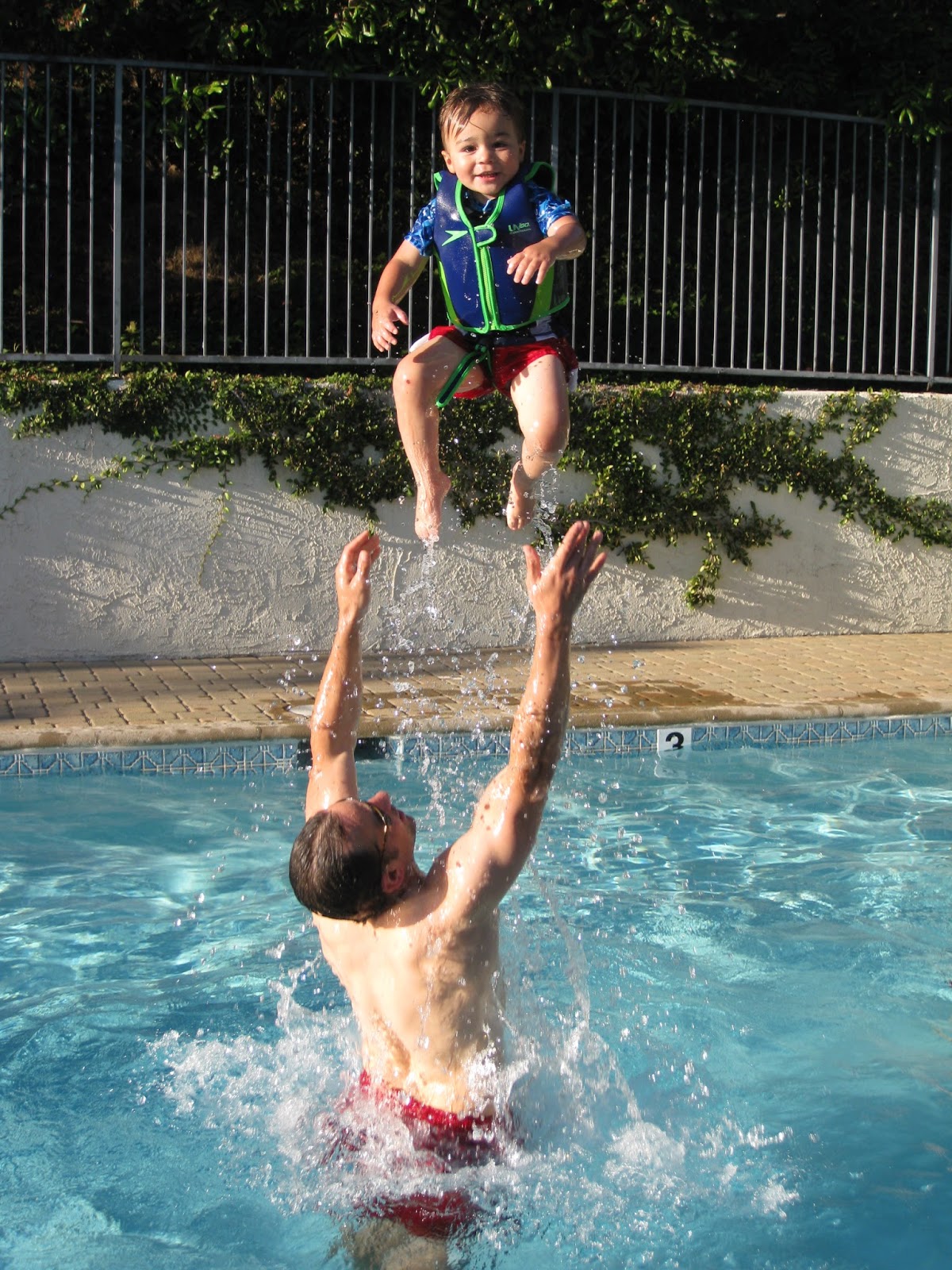
Now I watch my son as he tries to learn how to push off the wall of the pool and glide to his instructor, who offers him the appropriate high-fives when he follows instructions. I watch him kick his legs wildly as his arms flail at the water when he forgets about “big arms and scooping hands.” Every time we visit the pools, he does a little bit better. But sometimes he pushes off the wall, and instead of gliding to his instructor, he goes under. His head is gone, just like that. But then he sputters, laughs, and once again tries to execute the glide, scoop, and kick that constitutes swimming. 

In the rippling oasis of Lucile Cowle’s swim school, I watch some kids sink as their instructors lift them back up to the surface. I watch tiny, blond girls in frilly swimsuits whose spastic movements look like ecstatic drowning, but really it's swimming without coordination, and it's a delightful thing to see. When my son is done with his lesson, I change him into dry clothes and he picks out a red lollipop, which glows in the sun on the way back to our car where a notice about carjacking is pinned under the wiper. 


Saturday, May 11, 2013

The Circumstances of Your Birth

Either you were pushed from your mother's womb with great effort or a doctor cut the red lining and lifted you into the glare of hospital lights. Either your mother fed you from her breast or fed you formula like the majority of us 70s babies. In the worst circumstances your mother was gone too early for you to have a memory of her.

Either you were born whole or something happened in utero when cell met cell or during birth, and you've been forced, by nature of your bearing, to rise above a physical or mental handicap. In the worst circumstances, genetics or delivery has rendered you so broken that people avert their eyes when your mother rolls you into the neurologist's office.

Either you were born into a family as an only child, or you had siblings for companions. Either you were happy with this scenario or not. In the worst circumstances, you had a sibling once, but something happened to him or her. You may or may not remember. Your family may or may not talk about what they lost. Photos may or may not be displayed. This feature sometimes hangs like a thread. Pull it, and the whole family falls apart.


Either you were born of good stock, your parents both bright and attractive, neither harboring hidden fuck-ups, or you were born of parents, one or the other (or sometimes both), who struggle with deep-seated dysfunctions that were handed down to them by their parents, and you wonder if you can make it all stop with you. In the best circumstances, nurture overcomes nature, whether its a self-provided nurture or one afforded by family. In the worst circumstances, the defective aspect of your nature has been compounded by a lack of effective nurturing, and you either have no idea that you're a mess, or you have no idea how to clean up the mess that is you, thanks to a lack of both breeding and upbringing.

Either you were born in the best hospital your town has to offer, your mother given a basket of diapers and formula samples, or you were born in a home with a midwife and doula present. In the most remarkable situations you were born in an emergency room when your mother didn't even know she was pregnant, in the back of a cab because your mother waited too long and your father was on duty, or on your mother's kitchen floor because she was single and didn't get help in time. In worse situations, you were born in the grass of an impoverished country where you were sent off to an orphanage to wait, hopefully, for first-world parents you may or may not ever connect with.

Either you were born into a family that pulls you to them, the physical second-nature, all mouth-kisses, bear-hugs, and spooning in your parents' big bed, your mother's breasts as commonplace a sight as the hummingbird feeder in the kitchen widow, or you were raised by a family that was afraid of the body and its affections, and you're still unsure which way to tilt your head when you awkwardly wrap your arms around your father on special occasions. In worst situations, you were never shown tenderness and you've grown up unable to connect in a meaningful way with another human being.

Either you were born into a world where the car seats are Britax and the preschools are competitive, or you were born into a world where your mother has three jobs or no job, your food is government-provided, and you're often shipped off to the house of a grandparent or aunt when your mother or father is deemed an insufficient parent by the state. Many assume you'll amount to nothing. In worst situations, you're born in a country where famine and disease are commonplace, and any opportunities for labor that your mother may have are offered by first-world countries looking to take advantage of the circumstances of her birth.

Or some combination; it's rarely either/or. How blessed are you?

Tuesday, March 19, 2013

The Other Polarizing Disorder


Sometimes, late at night, well into my second glass of wine, my husband at work and my son sleeping, I mourn the loss of other people’s children. It’s usually during that hour when I’m immobilized by weariness yet unwilling to drag off to the bathroom to brush and wash, so I sit in front of the computer, study the photos of little boys, and have an unhealthy cry for Ronan, the one who died of tay-sachs; for the Staten Island mom whose sons were yanked from her arms by Hurricane Sandy; and for another mother whose entire family was washed away by the Southeast-Asian tsunami. My grief is discriminate; I mirror the bereavement of mothers who had and then who did not have anymore. I pluck stories from around the world about the entire annihilation of motherhood.

Let me tell you something about the way parenthood can change you: It is like an anti-anti-depressant or like a polarizing disorder that doesn’t just swing to and fro but that swings wildly. This is not to say that the opposite of anti-depressed is depressed or that it’s all bad; I’m talking about the loss of casual numbness about anything. Joy, for example, is amplified into something wildly exuberant. Love for a child can make you as giddy as a teenager, with all the angst-y hysteria, plus some added depth. On the other hand, anger is a coiled whip that now sits closer to your hands, and sadness can grab your lungs and squeeze them until your heaving tears in front of your computer at midnight for people you have never met. This sickness of parenthood may just be mine. I don’t know…

Fear, too. And compassion. They become more palpable. At Disney’s California Adventure there is a Ferris wheel that features gondolas on tracks that roll and swing out wildly hundreds of feet in the air above the park. Yesterday my niece and I rode up and around, and what looked like fun on the ground became nauseous, instinctual discomfort. Far below I could see my son asleep in his stroller, his grandmother waiting for us on the bench. Across from us in the gondola a girl visiting from Arizona clutched her father’s jacket in abject terror, the tears gathering but not yet falling. All I could do was talk to her in a low murmur: “It’s okay honey. I know it’s scary. We’ll be on the ground soon. Don’t worry.” And so on. I couldn’t stand to see her like that. I didn’t even know her.

I think this is probably more personal that I can fully grasp. Last summer my son suffered a series of partial seizures, and for a week we knew from his MRI read that something was wrong with him, but we didn’t know whether it was a disorder that would work itself out over time or whether he was showing the beginning signs of a “demyelinating process” that would piece-by-piece disassemble the puzzle of what makes him him. We wouldn’t know until we saw the neurologist. In fact, we’re still not completely positive. I have seen two full-blown febrile seizures that turned a very busy three-year-old into a vegetable for a half-hour. The things I have seen. I’m all too aware of the possibility of losing the one, small person that marks me as someone’s mother, not just from my own experiences with my only child, but also vicariously from others less fortunate, which sounds too mild to describe the catastrophic ending of motherhood.

At amusement parks there is always that game where you’re supposed to climb across a ladder made of rope to win a prize. The rope is anchored in the middle on either end so that the climber must rely on speed and balance to make it across, or the ladder will spin on its one tether and knock the climber off. This is what it feels like to be the parent of an only child. I imagine that two children would be like two tethers at either end, and I could climb across with more confidence, but since I wanted two and only have one, sometimes I feel like I’m spinning around on this rope ladder, and my grip is really compromised. I’m really worried I’m going to slip. I don’t trust my ability to balance.

Saturday, August 4, 2012

In Praise of the Mundane

We're deep into summer now, and the iridescent fig beetles will appear in a week to gorge on the overripe fruit. Running lady has grown predictably tan and predictably outpaces me every time I circle the reservoir. The grass grows brown and brittle, and in the afternoons I hide in the shade of a palm tree while Dexter runs through community sprinklers. We punctuate the long, hot days with self-serve frozen yogurt, and reliably the moon comes up behind the hill of houses once the day sweats off its fever. We watch it rise from our chairs around the glass table in the backyard where we drink coconut water and white wine. I've hunkered down into the predictability of existence. Let's praise it. 


Cultivating a love or skill

Let's praise the likelihood that Dexter will ace his preschool skills and transition smoothly into kindergarten, already able to read simple sentences and perform very basic math. Let's assume we'll run into expected disciplinary problems in grade school, and let's expect a few trips to the emergency room for stitches. He'll discover a skill or love and pursue it because that's what we do. Maybe he'll torture us by playing scales on the piano. Maybe he'll need shuttling to swim lessons. Maybe he'll be a math wiz. Let's rightfully figure that middle school will be awkward and painful sometimes, but he'll get through it. We can probably imagine that high school will be both hard and easy, that it could come off without a hitch, that he'll escape unscathed with enough of an education to go to an approved college. We can reasonably expect a part-time job serving burgers at Red Robin or painting houses until graduation. Let's praise the admirable career, even if it misses greatness. Let's cheer for a nice wife and charming kids. Let's weep with gratitude for the boring expectedness of it all. Let's rightly anticipate my son watching me lowered into the ground, and let's suggest he might cry, not because it's tragic, but because he will miss his mother, whose love for him was bottomless. Let's cross our fingers and hope and pray for a simple rolling forward of the years. 

Boy in the Plastic Bubble
Those of us who have had children late in life are accused of helicopter parenting because we keep a watchful, nervous eye on our sons and daughters. If this is true, it may be because we have seen a thing or two in our already long lives that let us know how someone can be fully present one minute and taken away the next. We have been witness to stories of loss, and sometimes those stories are merely once or twice removed from personal experience. Maybe we recognize the ephemeral quality of existence even as we watch our kids swing from the monkey bars. Perhaps we know that parenthood begins and ends with that one little boy panting around the house, pretending to be a dog. Because something bad could happen, and I could go from being a mother to once having been a mother, and that's the saddest narrative I can imagine at this wise and infertile age.
Broken Leg Pouty Face

At fifteen months, Dexter broke his leg. At two, he had a severe allergic reaction. At two and a half, he had a febrile seizure. Add dashes to the timeline of his existence with croup-like coughs, fevers, and the usual bruises. Now, at three, he's had a few incidents that suggest something neurological, but they have been so few as to only be suggestions. And so I watch him closely. This morning he pretended to fall three times in a mock ballet dance. Maybe the other falls were staged, too. Maybe I circle him and whir like the police copters that churn the sky in the high heat of these dependable, ordinary August days. 

Raise your glass of white wine or coconut water with me, dear reader, and let's have a toast for boredom. Cheers to you and your loved ones. 
Never-ending Summer